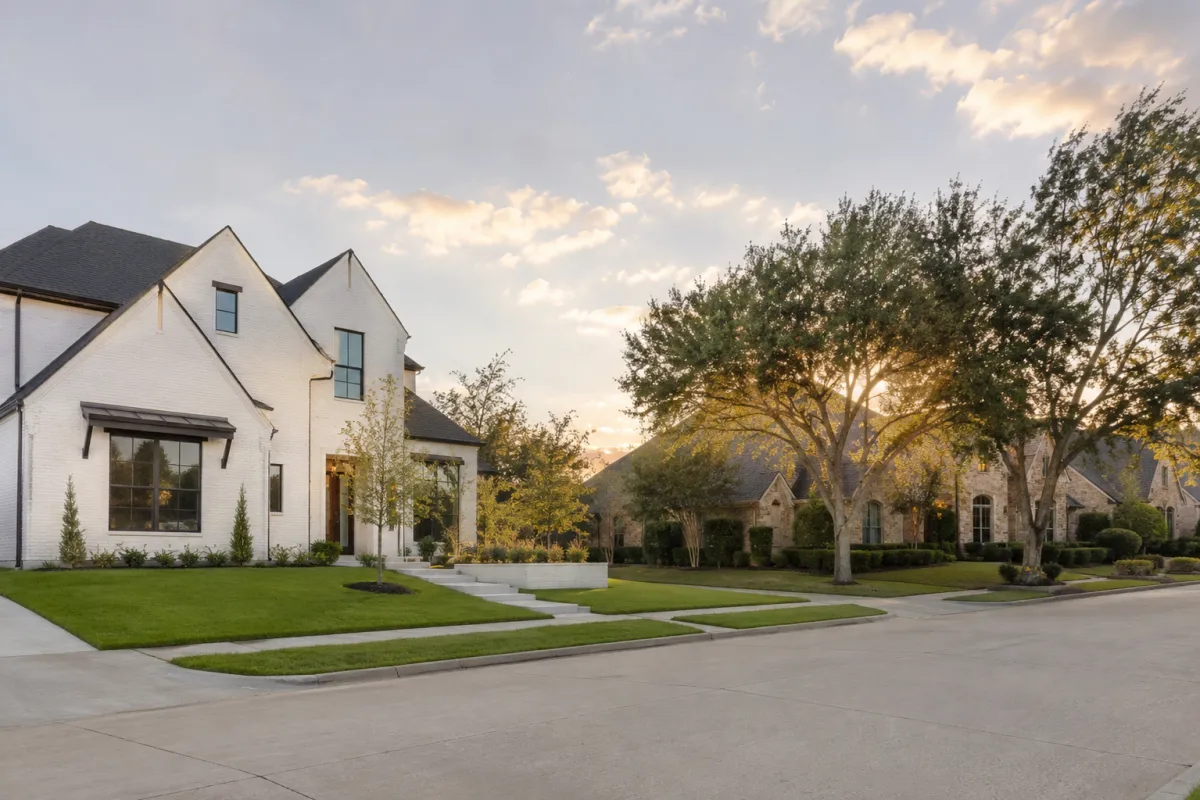
New Construction vs. Resale in Celina & Prosper 2026
If you've outgrown your current home and you're weighing a shiny new build against a resale a few streets over, here's the honest answer: in today's market, neither one is automatically the better deal. The smarter buy is the one that protects your equity going in, and that depends entirely on the numbers behind the offer, not the model home.
I work with growing families across Celina and Prosper who are making their first move-up purchase, and this is the question I get more than any other right now. It makes sense. You're standing in a brand-new community with a polished sales office, a flyer full of incentives, and a builder telling you to act fast, while three resale homes in the next neighborhood just dropped their price. It's a lot to weigh, and the stakes are six figures of your hard-earned equity.
So let me walk you through exactly how I think about this decision, what the spring 2026 data is telling us, and where the real traps are hiding.
First, understand the market you're actually buying into
The 2026 reset
The North Texas market has shifted, and it has shifted in your favor as a buyer. Through early 2026, Collin County moved into buyer-favorable territory: more homes for sale, longer days on market, and softer prices than the frenzy years. Roughly three out of four county sales recently closed below list price, which simply did not happen during the 2021 - 2022 boom.
Here's how that looks locally as of spring 2026:
~$519K Celina median sale price, down roughly 8% year over year
~$790K+ Prosper median sale price, down double digits from a year ago
~7+ mo. Months of supply in parts of Prosper, clearly a buyer's market
~6.5% 30-year fixed mortgage rate as of May 2026
Days on market have stretched dramatically. Homes in Celina have recently been taking around five months to sell, compared to roughly two months a year earlier. Translation: you have leverage and you have time.That single fact changes how you should read every builder incentive you're handed.
The builder incentive question and the math most buyers miss
Reading the fine print
Builders rarely want to cut their list price, because a lower comparable sale can drag down the value of every other home they're selling in that community. So instead of dropping the price, they move money into incentives: rate buy-downs, design-center credits, and closing-cost help.
Incentives can be genuinely valuable. But they are also where buyers most often leave money on the table, for one reason:
A $20,000 incentive is not the same as $20,000 off the price. Which one is better depends on your loan, your timeline, and how long you plan to stay.
A few things I always pressure-test before a client gets excited about an incentive number:
Is it tied to the builder's preferred lender? Many of the biggest incentives only apply if you finance through the builder's lender; sometimes at terms that quietly cost you more over time. The headline credit can be smaller than the rate or fee difference.
Is it a rate buy-down that disappears? A temporary buy-down lowers your payment for a year or two, then resets. If you don't plan to refinance or move quickly, that "savings" can evaporate right when your other costs are rising.
Would a price reduction serve you better? A lower purchase price lowers your loan balance, your property-tax basis, and your long-term interest, permanently. In a market where resale homes are negotiable, that's often the stronger play.
This is exactly the kind of side-by-side I run for every client before we ever write an offer. The point isn't to talk you out of a new build. It's to make sure the deal is structured to protect your equity, not the builder's pricing strategy.
Where new construction genuinely wins
The case for new
New construction
Everything is current code, with new systems and a builder warranty behind you.
You can choose finishes and layout instead of inheriting someone else's choices.
Right now, builder competition means real negotiating room; often more than buyers expect.
Lower maintenance and repair surprises in the first several years.
Resale
Established landscaping, fences, and finished amenities - no waiting on the next phase.
Often larger or more private lots in mature pockets of Prosper.
Sellers are negotiable in 2026, and a true price reduction beats a temporary credit.
You can see the actual neighborhood, traffic, and finished community before you commit.
For a move-up family, the deciding factor usually isn't "new vs. old." It's how long you plan to stay, how sensitive you are to monthly payment versus long-term cost, and how much disruption you can tolerate while a community is still being built around you.
The hidden costs nobody puts on the flyer
Protect your numbers
This is the part that catches buyers off guard, and it matters far more in newer Celina communities than in established Prosper neighborhoods. Before you compare two homes by sticker price, you have to compare their true cost of ownership.
MUDs and PIDs. Many newer developments finance their roads, water, and infrastructure through Municipal Utility Districts or Public Improvement Districts. These can add meaningfully to your annual tax bill, and they're rarely front-and-center when you're touring the model.
Higher effective tax rates. In communities where infrastructure is still being paid down, the effective tax rate can run higher than in a comparable resale neighborhood. On a $600K home, even a fraction of a percent compounds into real money every year.
HOA dues and phasing. Amenities you're paying for may not be finished yet, and dues can rise as the community matures.
School boundaries in motion. Both districts are growing fast. Prosper ISD and Celina ISD each have new campuses opening in 2026, which means attendance boundaries can shift. If schools are part of your decision, that's worth confirming in writing, not assuming.
When I evaluate two homes for a client, I normalize all of this into a single monthly and annual number. Two homes that look $30,000 apart on price can land in a completely different order once MUD assessments, tax rates, and HOA dues are on the table.
How I help move-up families decide
My approach
I treat this like the strategic decision it is, not a guessing game. My job is to make sure you can say afterward, "We didn't guess. We had a plan. We upgraded the right way." Here's what that looks like in practice:
Data-backed comparison. I build a true side-by-side of any new build against the best comparable resale options. Not just price, but total cost of ownership and resale outlook.
Incentive pressure-testing. I translate every builder incentive into what it's actually worth to you, given your loan and timeline.
Negotiation across every term. Price is one of more than 20 contract points I negotiate. Builders expect strong buyers to negotiate right now - most families simply don't know what's on the table.
Timeline alignment. If you're selling your current home to buy the next one, I structure the moves so you're not stuck with temporary housing or two mortgages.
The market has handed buyers more leverage than they've had in years. The families who win in 2026 are the ones who use it with a strategy - and who know the difference between a good headline number and a good deal.